Can You Paint Over Lead Paint or Does It Have to Be Removed?
You can often paint over lead paint rather than remove it, as long as the existing paint is intact, well-adhered, and not actively deteriorating, this approach is called encapsulation, and it’s a recognized method for managing lead paint on stable surfaces. Removal becomes necessary when the paint is loose, peeling, or being disturbed by renovation work like sanding or scraping. For homeowners in New London’s older neighborhoods, where many pre-1978 homes still have original trim and woodwork, knowing which category your paint falls into determines the right next step.
Is Encapsulation a Real Solution, or Just Covering Up a Problem?
Encapsulation is a legitimate, EPA-recognized lead management method but only when applied correctly to a stable surface. It involves covering properly prepared, intact lead-based paint with an approved coating system designed to seal it in place. The key requirement is that the existing paint must already be sound: firmly adhered, not cracking, and not showing signs of moisture damage underneath.
This is different from simply applying a new coat of regular paint over paint that’s already failing. If the original coating is loose, blistering, or peeling, painting over it doesn’t stop that deterioration, it just delays the moment the new coat fails along with the layer beneath it. Encapsulation products are also formulated differently than standard paint, built specifically to create a durable seal rather than just add color.
When Does Lead Paint Actually Need to Be Removed?
Removal becomes the right call in a few specific situations:
- The existing paint is already peeling, cracking, or deteriorating
- The project involves sanding, scraping, or otherwise disturbing the painted surface
- Windows, doors, or trim with lead paint are being replaced
- Structural repairs require removing the material the paint is on
In these cases, painting over the surface encapsulation or otherwise doesn’t address the underlying problem. Once paint is compromised enough to flake or generate dust during normal renovation work, it needs to be professionally removed or the surface needs to be replaced.
How Do You Know Which Category Your Paint Falls Into?
The paint’s condition, not its age or appearance, is what determines whether encapsulation or removal makes sense. A visual and physical inspection typically checks:
- Whether the paint is firmly bonded to the surface or lifting at the edges
- Whether there’s any cracking, alligatoring, or chalking
- Whether moisture has gotten underneath the coating
- Whether the surface will be disturbed by the planned work
If a surface passes all of these checks — solid, intact, no moisture issues, and not part of a renovation that requires sanding or removal — encapsulation is often the more practical and less invasive option. If it fails any of them, removal (using lead-safe practices) is the more durable path forward.
What Does a Lead-Safe Encapsulation Project Actually Involve?
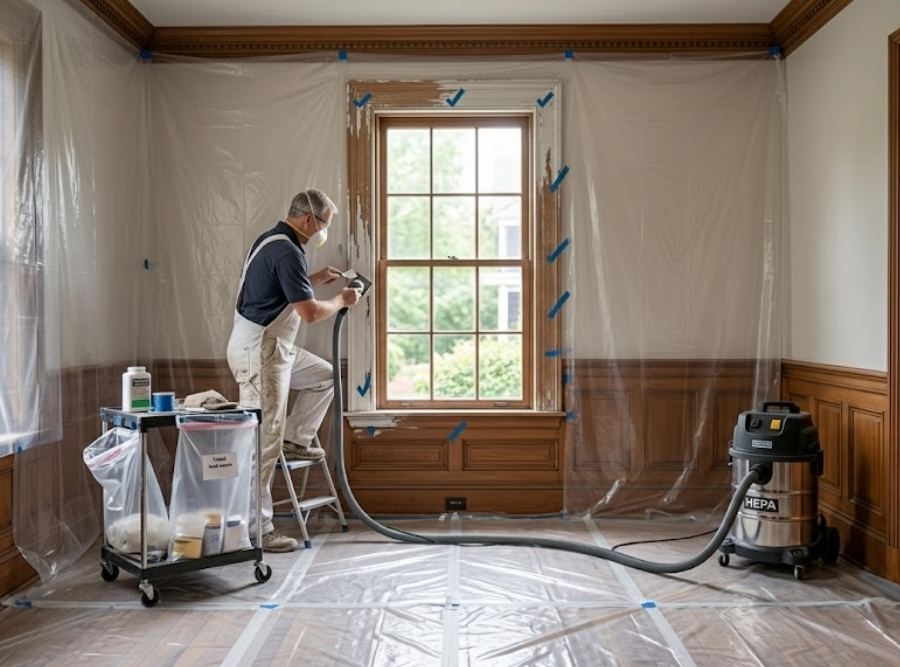
A proper encapsulation project isn’t just an extra coat of paint. It typically includes:
- Testing the surface to confirm lead presence, if not already known
- Cleaning the surface to remove dust, dirt, and any loose material without aggressive sanding
- Repairing any small areas of damage using lead-safe methods
- Applying an approved encapsulant product designed for the surface material
- Following manufacturer specifications for coverage and cure time
This is different from standard interior or exterior painting prep, since the goal is sealing the lead-based layer permanently rather than just achieving a smooth topcoat.
If you have a New London home with intact but aging painted surfaces and you’re not sure whether encapsulation or removal is the right approach, the Simons Painting & Drywall team can evaluate the paint’s condition before recommending next steps.
Learn more on our Drywall Repair & Installation page, or see our related guide on sanding old paint safely in pre-1978 homes.
Frequently Asked Questions About Painting Over Lead Paint
Is it safe to paint over lead paint instead of removing it?
Yes, if the existing lead paint is intact, well-adhered, and not deteriorating, this is called encapsulation and is a recognized lead management method. It’s not appropriate for paint that’s already peeling, cracking, or being disturbed by renovation work.
How do I know if my old paint needs to be removed instead of encapsulated?
If the paint is loose, cracking, blistering, or showing moisture damage, or if your project involves sanding, scraping, or replacing the surface it’s on, removal using lead-safe practices is the appropriate approach rather than painting over it. Intact, stable paint that won’t be disturbed is generally a better candidate for encapsulation.
Is encapsulation just a cheaper way to avoid dealing with lead paint properly?
No, proper encapsulation is a recognized, EPA-acknowledged method for managing lead paint, using specific products designed to create a durable seal over a stable surface. It’s a legitimate long-term solution when the underlying paint is sound, not a shortcut.
Can I encapsulate lead paint myself with regular paint and a primer?
Standard paint and primer aren’t the same as an approved encapsulant product, which is specifically formulated to create a durable, sealing bond over lead-based paint. Using the wrong product can mean the coating doesn’t perform as intended, so it’s worth confirming the right product and approach before starting.
Shea Simons is the owner of Simons Painting & Drywall, a family-owned painting and refinishing company serving Connecticut Shoreline communities from East Lyme and Niantic to Old Saybrook, Madison, and Mystic. Shea and his team specialize in interior and exterior painting, drywall repair and installation, and fine refinishing work for cabinets, furniture, and custom walls. Homeowners along the shoreline know Shea’s crew for meticulous prep work and a finish built to hold up against coastal salt air and humidity.