
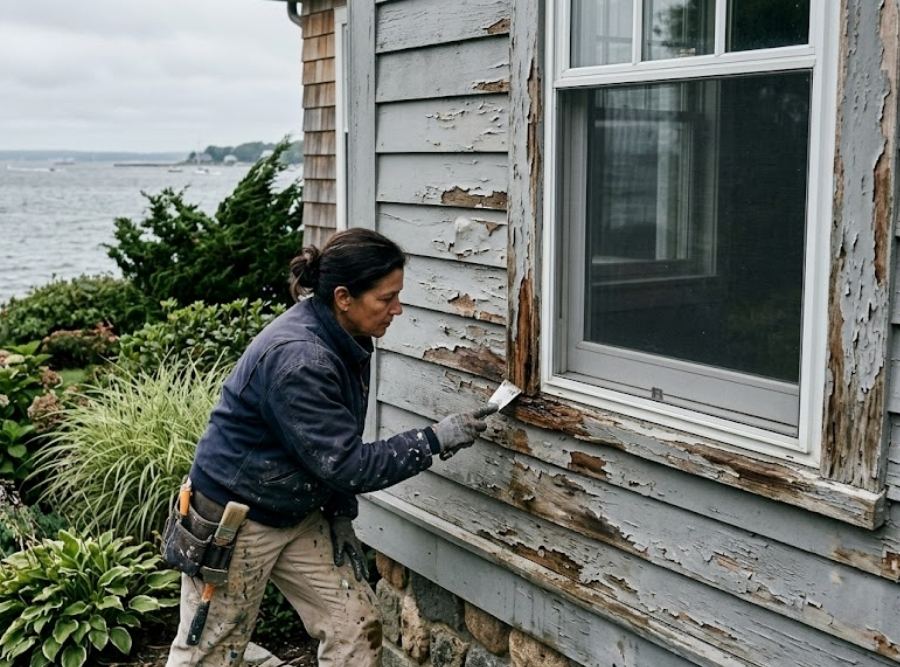
What Causes Bubbling or Peeling Paint Near Long Island Sound?
Bubbling or peeling exterior paint near Long Island Sound is usually caused by moisture trapped beneath the paint, not by the paint itself failing. Coastal humidity, salt-laden air, failed caulking, aging primer, poor surface prep, and repeated wet-dry cycles can all cause paint to lose adhesion, blister, and eventually peel away from siding or trim. Identifying where that moisture is coming from rather than just scraping and repainting the blister is what determines whether the repair actually lasts.
Does Bubbling Paint Start From the Outside or the Inside?
Most paint blisters start from the inside. Moisture trying to escape from beneath the paint film builds pressure against the coating until it separates from the surface — first showing up as raised bubbles or soft spots, then rupturing to peel and expose bare wood. Moisture gets in several ways: rainwater through cracked caulk around windows, deteriorated trim joints, or aging flashing; humidity that wood slowly absorbs, especially in shaded areas that stay damp long after rain; and salt deposits along the shoreline that hold moisture against painted surfaces longer than inland homes typically experience. Bubbling tends to show up first around windows, fascia boards, soffits, corner trim, and clapboard joints — the spots that naturally see the most water exposure.
Is Salt Air Alone Responsible for Paint Peeling Near the Sound?
Rarely by itself. Salt air accelerates wear on a paint system that’s already under stress rather than causing peeling on its own. Salt-laden moisture settles on siding and trim while UV sunlight weakens the paint film, together reducing the coating’s flexibility. Add Connecticut’s seasonal moisture cycling — summer humidity expanding the wood, winter heating contracting it, freeze-thaw cycles repeatedly forcing moisture in and out and nor’easter wind-driven rain reaching areas that normally stay dry, and even a quality paint job comes under real pressure.
Exposure varies by location: south-facing walls tend to see more UV damage, shaded walls stay damp longer, and homes directly on the water in Niantic Bay, Black Point, Crescent Beach, or Giants Neck typically face stronger wind and salt exposure than homes farther inland around Flanders. That’s a big part of why one side of a house or one house versus its neighbor can start peeling years earlier than another.
Can Poor Preparation Cause Paint to Peel Even Without a Moisture Problem?
Yes. Sometimes the failure starts the day the previous paint job was finished, not from ongoing environmental exposure. Paint applied over weathered wood without adequate priming, or over loose paint that was only scraped around the edges, can look great initially and then start lifting within a few seasons because it never bonded to a stable surface. Common prep-related causes of early paint failure include:
- Painting over loose or peeling paint
- Applying paint to damp wood
- Skipping primer on bare siding or repairs
- Using lower-grade coatings in a harsh coastal environment
- Leaving deteriorated caulk around windows and trim
- Inadequate cleaning of dirt, mildew, or salt deposits before painting
- Painting during conditions that slow proper curing
In these cases, the paint itself usually isn’t defective, it just never had the chance to bond properly.
Why Doesn’t Simply Repainting a Bubbling Area Fix the Problem?
Because the blister is a symptom, not the cause. Scraping loose paint and applying a fresh matching coat looks fine through the following summer, but if moisture is still trapped beneath the surface or still entering through the same pathway, the new paint typically fails the same way the old one did. As long as water keeps reaching the wood through failed caulk, deteriorated flashing, open joints, or overflowing gutters, the paint system stays under constant stress.
Painting over damaged wood instead of repairing it makes this worse. Paint can’t restore deteriorated siding or seal moisture inside wood permanently — sealing wet wood under a fresh coat often speeds up peeling, since trapped moisture eventually builds enough pressure to push the new paint off again. A lasting fix means correcting what let moisture in before repainting starts.
How Do You Find the Real Cause Behind a Peeling Section?
The actual moisture source is often several feet from where the paint is visibly failing — water travels behind siding, trim, and flashing before showing up somewhere else. A thorough evaluation looks at:
- Window trim and siding joints
- Fascia boards and soffits
- Gutters and flashing
- Caulk lines
- Whether peeling concentrates on one elevation, around windows, under roof overhangs, or in shaded, slow-drying areas
Those patterns usually explain the cause better than the blister itself. Sometimes the fix is straightforward — replacing deteriorated caulk, correcting a small flashing issue, or fixing gutter overflow removes the moisture source before repainting even begins. Other times, rotten trim or siding needs repair or replacement because it can no longer hold paint. Once the underlying condition is corrected, the surface can be properly scraped, sanded, primed, and repainted with a coating built for Connecticut’s coastal exposure.
When Should Bubbling Paint Be Addressed Before It Gets Worse?
Small blisters are an early warning that moisture is starting to affect the exterior, and addressing them while the damage is limited usually prevents more expensive repairs later. Once bare wood stays exposed for extended periods, repeated wetting and drying can lead to swelling, cracking, and rot that goes well beyond the paint itself. Bubbling or peeling paint is worth treating as something to investigate, not just something to repaint.
If you’re noticing bubbling, peeling, or exposed wood on your home’s exterior in East Lyme, Niantic, or another shoreline community, the Simons Painting & Drywall team can evaluate what’s actually causing it before recommending a repair.
Learn more on our Exterior Painting page.
Frequently Asked Questions About Bubbling and Peeling Paint
Does bubbling paint mean the paint was low quality?
Not usually. Bubbling almost always indicates trapped moisture pushing against the paint film from underneath rather than a defective product. Even premium paint will blister if applied over damp wood or if moisture keeps entering through failed caulk or flashing afterward.
Why does my house keep peeling in the same spot every year?
If a spot keeps failing after being touched up, the underlying moisture source such as failed caulk, a flashing gap, or an overflowing gutter is likely still active and wasn’t addressed during the repair. Repainting without correcting that source typically leads to the same area bubbling again within a season or two.
Is salt air the main reason paint peels near Long Island Sound?
Salt air accelerates wear on an already-stressed paint system, but it’s rarely the sole cause of peeling on its own. Moisture intrusion through failed caulk, aging flashing, or inadequate surface preparation is usually the more direct cause, with coastal conditions making the underlying problem progress faster.
Can I just paint over a small paint bubble to fix it?
No, painting over a bubble without addressing the trapped moisture underneath usually results in the same area peeling again, sometimes faster than before. The blister needs to be scraped back to a sound surface, the moisture source identified and corrected, and the area properly primed before repainting.

Shea Simons is the owner of Simons Painting & Drywall, a family-owned painting and refinishing company serving Connecticut Shoreline communities from East Lyme and Niantic to Old Saybrook, Madison, and Mystic. Shea and his team specialize in interior and exterior painting, drywall repair and installation, and fine refinishing work for cabinets, furniture, and custom walls. Homeowners along the shoreline know Shea’s crew for meticulous prep work and a finish built to hold up against coastal salt air and humidity.