
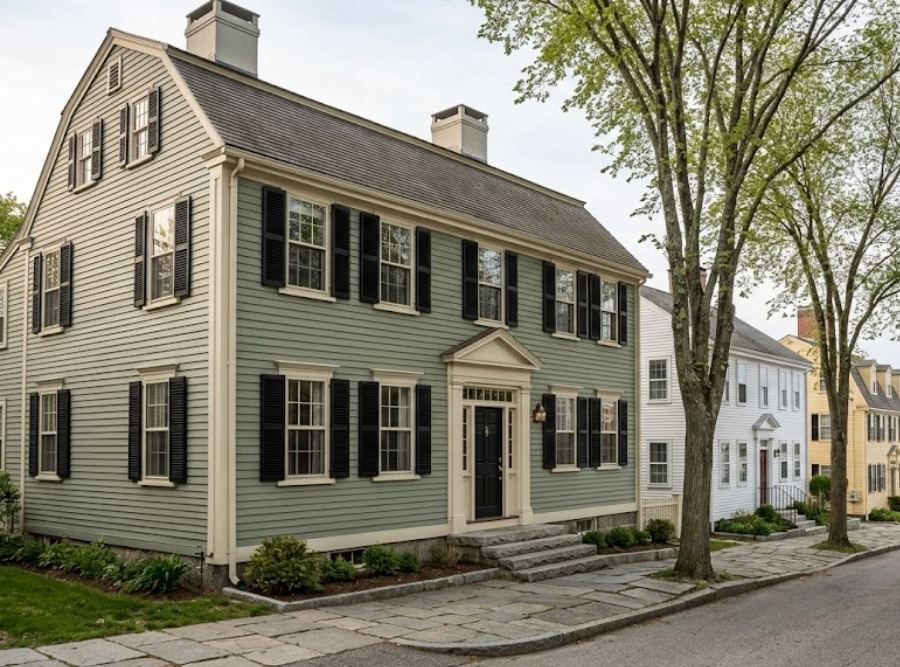
Historic Colonial home in Stonington Borough featuring a traditionally appropriate exterior paint color palette and restored wood trim.

What Paint Colors Are Approved in the Stonington Borough Historic District?

Quick Answer:
Stonington Borough does not appear to publish one universal list of paint colors that is automatically approved for every historic property. Exterior color choices should be evaluated in relation to the building’s architectural period, existing materials, surrounding streetscape, and any current Historic District Commission requirements, so homeowners should confirm whether review is needed before purchasing paint or beginning work.

A paint color can look perfectly appropriate on a sample card and still feel wrong once it covers an entire historic façade. That concern is especially important in Stonington Borough, where narrow streets, closely spaced homes, maritime buildings, Colonial and Federal architecture, and long-established exterior color relationships create a streetscape that is visually connected. The Borough is widely recognized as a historic New England coastal village, with historic properties concentrated around Water Street, Cannon Square, Wadawanuck Square, and the surrounding waterfront streets.

For homeowners, the practical question is often not simply, “Which color looks good?” It is, “Which color is likely to be considered appropriate for this particular house?” There is an important difference. A color taken from a manufacturer’s historic collection may be a useful starting point, but the word historic on a paint card does not guarantee that the color suits the age, style, previous finish, or setting of a specific Borough property. Before scheduling exterior painting, it is wise to verify the current review process and determine whether the proposed body, trim, shutter, door, or masonry colors need to be submitted.

There Is No Single Historic Color That Fits Every Borough Home

One of the most common misconceptions is that all Colonial or early New England homes were painted white. White has certainly become a familiar part of the regional landscape, but it is not the only historically appropriate option, and a stark modern white may not be the best fit for every older building. Historic exterior colors were influenced by the architectural period, available pigments, building materials, owner resources, regional traditions, and later changes made over generations.

Stonington Borough contains a mixture of Colonial, Federal, Greek Revival, Victorian, maritime, commercial, and vernacular buildings rather than one uniform architectural style. Its preserved character comes partly from that variety, along with the close relationship between building scale, trim details, doors, windows, siding, and neighboring properties. A muted gray-green that works beautifully on a simple Federal-style home may not produce the same result on a more decorative Victorian property, where several coordinated colors may be used to distinguish brackets, cornices, window trim, or other architectural details.

Historically compatible palettes often include restrained shades such as warm whites, creams, soft grays, muted blues, gray-greens, ochres, deep reds, traditional browns, and darker accent colors. These are not guaranteed approvals, nor should they be treated as an official Borough list. They are broad color families that frequently feel at home on historic New England architecture when selected carefully. The final choice should still respond to the building itself rather than to a trend, a neighboring house, or a paint collection name.

Historic Review Is About More Than the Main Siding Color

Homeowners sometimes focus entirely on the field color—the largest color covering the clapboards or shingles—while overlooking how much the trim and accent colors affect the building’s overall appearance. In a historic district, the relationship between the siding, window sash, casings, cornice, shutters, doors, porch details, and foundation can matter as much as the individual colors.

A traditional palette may use a relatively quiet body color, a lighter or darker trim color, and a restrained accent at the front door or shutters. A modern scheme with very bright white trim, black windows, a highly saturated front door, and sharply contrasting details may look attractive on new construction but appear visually disconnected from an older Borough streetscape. That does not mean contrast is always inappropriate. It means the contrast should make sense for the building’s period, architecture, and surrounding context.

Finish sheen deserves consideration as well. High-gloss coatings can make repaired wood, uneven clapboards, old brush marks, and layers of previous paint far more noticeable. Historic exteriors often look more natural with finishes that provide durability without creating an overly slick or reflective appearance across broad siding surfaces. Doors and selected trim may use a stronger sheen where appropriate, but the coating system should also remain compatible with the underlying material and previous paint layers.

A Manufacturer’s Historic Collection Is a Starting Point, Not an Approval

Benjamin Moore, Sherwin-Williams, and other paint manufacturers offer historic color collections that can help narrow an overwhelming number of choices. These palettes are useful because they often include subdued, traditional colors that coordinate well with older New England architecture. They can help homeowners move away from trend-driven colors that may look dated quickly or stand out too sharply within the Borough.

The mistake is assuming that any color found in a historic collection is automatically acceptable for any historic home. Paint companies create broad collections for many architectural periods and regions. A shade associated with Victorian architecture may not be the best choice for an early Federal façade, and a color that works on a large rural farmhouse may overpower a narrow house on a compact Borough street.

The most dependable selection process starts with the property rather than the fan deck. Homeowners should consider:

  • The age and architectural style of the building
  • Existing or documented earlier colors
  • The material being painted
  • The relationship between body, trim, sash, doors, and shutters
  • Nearby historic buildings and the broader streetscape
  • How the color changes in direct sun, shade, fog, and coastal light

Large painted samples are much more useful than relying on small chips. Stonington’s coastal light can make colors appear cooler, brighter, or more washed out at different times of day, while north-facing and shaded elevations may look considerably darker. A color that seems muted in a store can become much stronger when applied across an entire exterior.

Confirm the Review Process Before Paint Is Ordered

The safest time to resolve historic-district questions is before the contractor is scheduled and before gallons of custom-tinted paint have been purchased. Homeowners should contact the appropriate Borough or municipal office, describe the scope of the project, and ask whether repainting in the existing colors is treated differently from a full color change. They should also confirm whether changes to shutters, doors, trim, masonry, or previously unpainted surfaces require additional review.

This distinction matters because maintenance painting and a visible alteration may not always be treated the same way. Repainting an existing, established scheme may be more straightforward than introducing an entirely new palette, but homeowners should not assume an exemption without confirmation. Current procedures, application requirements, and commission interpretations can change, so direct guidance from the responsible local authority should take priority over online discussions or a neighbor’s past experience.

When documentation is requested, it may help to prepare photographs of the entire façade, close views of the siding and trim, manufacturer color names or codes, painted samples, and a simple explanation of where each color will be used. Providing a coordinated proposal is generally clearer than submitting one body color without showing how the trim, doors, shutters, and other details will relate to it.

Professional Preparation Is Just as Important as Choosing the Right Color

For many historic homes, the paint color receives most of the attention, but the quality and longevity of the finished project often depend far more on the preparation that happens beforehand. Many of the homes within Stonington Borough date back well over a century, and original wood siding, decorative trim, window casings, cornices, and porch details deserve a different level of care than newer construction. Aggressive sanding, improper scraping techniques, or incompatible repair materials can damage historic wood that may be difficult—or impossible—to replace with an exact match.

Older paint systems also deserve careful evaluation before work begins. Homes built before the late 1970s may contain layers of lead-based paint beneath more recent coatings. That does not necessarily prevent repainting, but it does change how surface preparation should be approached. Rather than removing every layer of paint unnecessarily, many projects focus on stabilizing sound coatings, repairing damaged areas, and creating a properly prepared surface for the new finish. This approach helps preserve historic materials while reducing unnecessary disturbance to older paint layers.

Along Connecticut’s shoreline, preparation is equally important because of the local climate. Salt-laden air, high humidity, wind-driven rain, and seasonal freeze-thaw cycles all place additional stress on exterior coatings. Even the most historically appropriate color will not perform well if loose paint remains, deteriorated caulk is ignored, moisture has entered the wood, or failing primer is simply painted over. A successful project begins with understanding the condition of the home as much as selecting the right color palette.

How Simons Painting & Drywall Approaches Historic Exterior Painting

Painting a historic home is different from painting a modern subdivision house, and we believe the approach should reflect that difference. At Simons Painting & Drywall, we understand that homeowners are often balancing several priorities at once. They want to protect their investment, preserve the architectural character of the property, comply with any applicable historic district requirements, and choose colors that will continue looking appropriate for years rather than following short-lived design trends.

Our process begins with evaluating the existing exterior rather than immediately discussing paint colors. We look at the condition of the siding, trim, previous coatings, caulking, and any areas where moisture or age may have affected the wood. If the property is located within or near a historic district, we encourage homeowners to confirm any review requirements before paint is purchased or work begins. Taking that step early helps prevent unnecessary delays, avoids ordering custom colors that may later need to be changed, and gives everyone involved a clearer understanding of the project’s scope.

Once the color selection and preparation plan are established, our focus shifts to producing a finish that respects the home’s architecture. That means careful surface preparation, appropriate repair techniques, quality primers where needed, and premium exterior coatings that provide durability while allowing the historic details of the home to remain the focal point. Our goal is never to make a historic house look brand new. Instead, it is to help preserve its character while providing the long-term protection that Connecticut’s coastal climate demands.

The Best Historic Paint Color Is the One That Fits the Home

Many homeowners begin their search looking for an official list of approved paint colors, but the better question is whether the proposed colors are appropriate for the individual building and its historic surroundings. Stonington Borough’s architectural character has been preserved because generations of homeowners have maintained their properties with respect for the neighborhood as a whole rather than treating each home as an isolated project.

If you’re planning to repaint a historic property, start by confirming whether your project requires review and whether a color change affects that process. Once those questions are answered, selecting a historically compatible palette becomes much easier because the focus shifts from finding one “approved” color to choosing colors that complement the home’s architecture, neighboring historic buildings, and the unique coastal character of the Borough.