
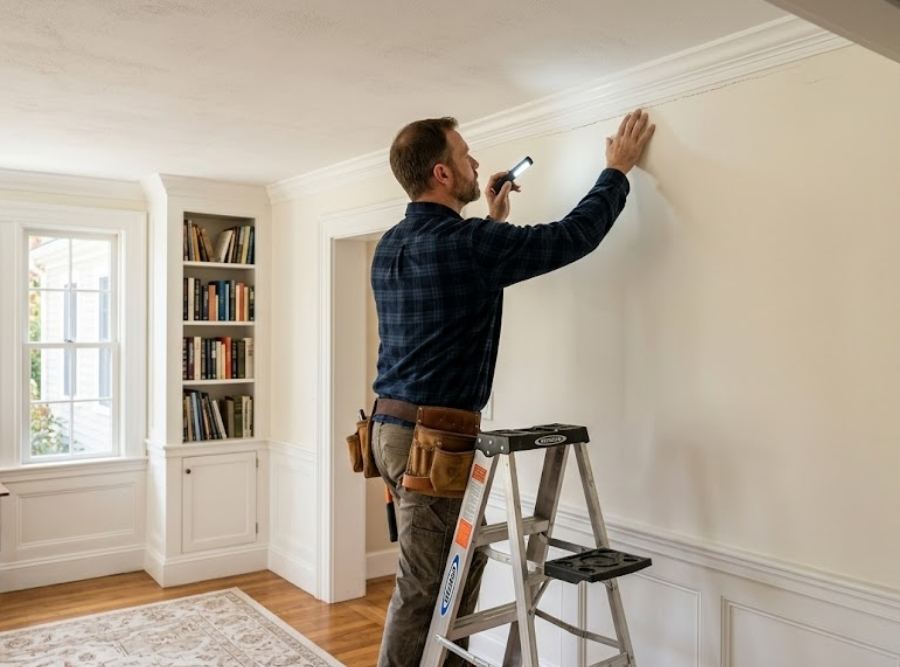
Why Does Drywall Keep Cracking Near the Ceiling?
Ceiling-to-wall cracks are usually caused by normal seasonal movement in a home’s framing rather than a structural problem. In East Lyme, coastal humidity, winter heating, roof truss movement, and natural settling can all cause the joint where wall meets ceiling to crack repeatedly year after year, though cracks that keep growing, or come with sagging, water stains, or sticking doors, are worth a closer look. Understanding why the crack keeps returning matters more than just patching it again.
Why Do Cracks Keep Forming Where the Wall Meets the Ceiling?
Houses are designed to move slightly. Wood framing absorbs moisture and expands during humid weather, then contracts as indoor air dries out during winter heating season. That movement is usually measured in fractions of an inch, but drywall joint compound and tape are far less flexible than the framing behind them — repeated seasonal changes create stress along drywall joints, especially where walls meet ceilings.
East Lyme’s climate makes this more pronounced. Humid summers near Long Island Sound let framing lumber absorb moisture, while cold winters and continuous indoor heating dry the wood back out. That cycle typically produces a thin crack that widens slightly in winter, becomes less noticeable in summer, and repeats annually. Upper-floor bedrooms, rooms directly under the roof, cathedral ceilings, and long ceiling spans see this most often since they’re closest to roof framing and attic temperature swings.
What Is Truss Uplift, and Why Does It Cause the Same Crack to Return Every Year?
Truss uplift is one of the most misunderstood causes of recurring ceiling cracks — the name sounds alarming, but it’s typically a normal seasonal condition rather than a construction defect. Roof trusses are engineered wood structures spanning the width of a home. In Connecticut’s cold winters, the upper portion of the truss stays colder and drier than the bottom chords inside the heated living space. Because the wood responds to different moisture conditions at once, parts of the truss can shift slightly upward during winter before settling back closer to their original position as conditions change again.
That movement puts stress right where ceiling drywall meets the interior walls. Since drywall is attached to both surfaces, even minor truss movement can create enough tension to crack the joint compound or tape — the drywall joint is simply responding to the same seasonal forces again, not failing.
Recurring cracks caused by framing movement typically share these traits:
- Appears in the same location every year
- More noticeable in winter
- Partially closes during warmer months
- No other foundation problems elsewhere in the home
- Doors and windows continue operating normally
- Follows the ceiling joint rather than appearing randomly across the wall
Could the Crack Be Caused by Something Other Than Seasonal Movement?
Yes. Drywall installation itself affects how a joint holds up — improper taping, insufficient fastening, inadequate joint compound, or poor prep can cause a joint to fail sooner than expected. Recently renovated homes can also develop cracks where new drywall meets older framing, since the two sections respond differently to seasonal movement.
Moisture is another factor that shouldn’t be overlooked. If a ceiling crack comes with yellow or brown staining, peeling paint, soft drywall, or a musty smell, the cause may be a roof leak or moisture intrusion rather than seasonal movement — water weakens tape and joint compound, causing joints to separate much faster. Repairing the crack without addressing the moisture source almost always brings the problem back.
Warning signs that go beyond a typical seasonal joint crack include:
- Cracks becoming noticeably wider each season
- Ceiling drywall beginning to sag
- Water stains developing around the damaged area
- Doors or windows suddenly sticking
- Floors becoming uneven
- Multiple large cracks appearing across several rooms
- Significant gaps opening between trim and the ceiling
Why Doesn’t a Cosmetic Repair Always Last?
A ceiling joint gets patched, sanded, primed, and painted then the same crack reappears the following winter. That doesn’t necessarily mean the repair failed; it usually means the framing behind it is still moving. A joint repaired in spring, when humidity is moderate and framing is relatively stable, can hold through summer and fall, then crack again once heating season dries and contracts the wood.
This doesn’t mean every recurring crack needs structural work — many ceiling joint cracks are entirely cosmetic. But a lasting repair usually involves more than a layer of fresh joint compound. It typically requires:
- Removing loose or failed drywall tape
- Reinforcing the joint
- Checking and adding fasteners where needed
- Rebuilding the joint properly before the finish coat goes on
When Does a Recurring Ceiling Crack Need Further Evaluation?
A recurring crack is worth closer attention if it comes with other changes in the home — doors suddenly hard to close, windows that won’t latch, noticeably uneven floors, or new cracks appearing in different rooms. It’s also worth pausing cosmetic repairs if the crack widens significantly rather than just reopening as a fine hairline, or if the ceiling starts sagging or shows water stains.
The key distinction is between movement that stays roughly consistent year to year and movement that keeps getting worse. Seasonal cracks tend to reopen to a similar width each winter and shrink back in warmer weather; structural movement tends to progress over time rather than following a predictable seasonal pattern. Photographing the crack every few months can help confirm which pattern is showing up.
If your East Lyme home has a ceiling crack that keeps coming back, the Simons Painting & Drywall team can evaluate whether it’s normal seasonal movement or something that needs a closer look before repairing it.
Learn more on our Drywall Repair & Installation page.
Frequently Asked Questions About Ceiling Cracks
Is a crack where my ceiling meets the wall a sign of a structural problem?
Usually not, most ceiling-to-wall cracks come from normal seasonal wood movement or roof truss uplift rather than structural damage. It’s worth a closer look only if the crack keeps widening or comes with sagging, water stains, or sticking doors elsewhere in the home.
What is truss uplift and is it dangerous?
Truss uplift is a normal seasonal condition where the upper part of a roof truss shifts slightly due to different moisture levels than the bottom chords inside the heated space, putting stress on the ceiling drywall joint below. It’s typically not a structural defect, though it commonly causes the same ceiling crack to reopen every winter.
Why does my ceiling crack come back every winter even after I’ve repaired it?
If the framing behind the joint is still moving seasonally, applying fresh joint compound alone provides only a temporary fix since the same stress returns each heating season. A lasting repair usually needs the loose tape removed and the joint properly reinforced before the finish coat is applied.
How can I tell if a ceiling crack is just seasonal or something more serious?
Seasonal cracks typically reopen to about the same width each winter and shrink back during warmer months, while doors, windows, and floors continue to behave normally. If the crack keeps growing instead of following that pattern, or if it’s accompanied by sagging, water stains, or sticking doors, it’s worth having evaluated before a cosmetic repair.

Shea Simons is the owner of Simons Painting & Drywall, a family-owned painting and refinishing company serving Connecticut Shoreline communities from East Lyme and Niantic to Old Saybrook, Madison, and Mystic. Shea and his team specialize in interior and exterior painting, drywall repair and installation, and fine refinishing work for cabinets, furniture, and custom walls. Homeowners along the shoreline know Shea’s crew for meticulous prep work and a finish built to hold up against coastal salt air and humidity.