
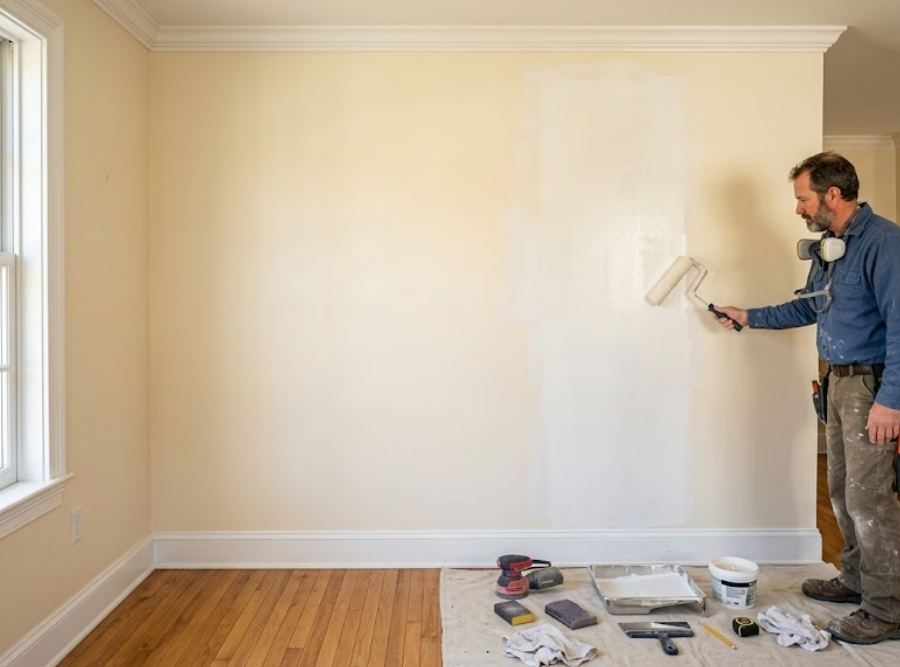
Why Does My Drywall Patch Still Show Through the Paint?
A drywall patch usually shows through paint because the repaired area absorbs paint and reflects light differently than the surrounding wall — a phenomenon called drywall flashing. It’s most often caused by differences in surface texture, primer, porosity, or paint sheen, not because the paint color is wrong. Proper priming and finishing, not another coat of paint, are what make a repair truly disappear.
What Is Drywall Flashing?
Drywall flashing (also called paint flashing) is when a repaired section reflects light differently than the surrounding wall, making it visible even when the paint color matches exactly. The patch can look dull or glossier than the wall around it, slightly lighter or darker, and its appearance can shift throughout the day as natural light changes.
This happens because a repaired wall isn’t one continuous material anymore, it’s several different surfaces working together: fresh joint compound, existing painted drywall, exposed drywall paper, feathered repair edges, and newly sanded areas. Each absorbs primer and paint differently, so even with identical finish paint, they continue reflecting light differently because their surface characteristics aren’t the same. Joint compound is especially porous, if it isn’t properly sealed with the right primer, it absorbs finish paint faster than the surrounding wall, creating a visible transition.
Does This Mean the Paint Color Was Matched Wrong?
No. Identical paint colors can look dramatically different depending on the surface underneath them — light reflects from smooth surfaces differently than rough ones, and from porous materials differently than sealed ones, and the eye reads that as color variation even when the paint itself is identical.
A few signs point to flashing rather than a color-matching problem:
- The paint matches, but the repair still stands out
- The wall looks fine until morning sun hits it
- The patch only shows under ceiling lights
- Every repair shows up in photos
- Repainting it multiple times hasn’t changed anything
If a patch were genuinely the wrong color, it would look off consistently in every lighting condition. Flashing instead gets more noticeable under strong sunlight or bright LED lighting, because those conditions exaggerate small differences in texture and sheen rather than color itself.
What Actually Causes Drywall Patches to Show Through Paint?
Most cases trace back to a combination of these common finishing issues:
- Inadequate priming — fresh joint compound absorbs paint much faster than previously painted drywall, so skipping a proper drywall primer (or only spot-priming the patch) leaves the finish coat drying unevenly.
- Texture mismatch — even a perfectly flat repair may not match the wall’s existing roller stipple or the subtle texture built up over years of repainting.
- Sanding errors — over-sanding can polish joint compound so it reflects light differently, while under-sanding leaves feather edges or scratches that show once painted.
- Paint sheen — satin, eggshell, semi-gloss, and gloss finishes reflect far more light than flat paint, so any prep imperfections underneath become more visible rather than less.
- Spot painting — repainting only the damaged area instead of the full wall creates a different roller texture, film thickness, and sheen than the rest of the surface.
Why Does the Patch Look Fine at Night but Show Up in Daylight?
This is critical lighting — light hitting the wall from a low angle, creating shadows and reflections that expose small differences in texture the repair had all along. Homes with large south- or west-facing windows can flood a room with strong afternoon light, and even modern LED recessed lighting produces crisp, directional light that makes ridges, feather edges, or sheen variations easier to spot. The repair hasn’t gotten worse, it’s just being lit in a way that reveals it.
Phone cameras make this more noticeable too, since they automatically boost contrast and sharpen detail, making subtle texture differences look far more dramatic than they appear in person which is why patches that seem barely visible in the room can jump out in real estate photos.
Will Adding More Paint Coats Fix a Visible Patch?
No, and it often makes things worse. Flashing is rarely caused by insufficient paint coverage — joint compound that isn’t properly sealed keeps absorbing paint differently no matter how many coats go on, and a texture mismatch doesn’t disappear under more paint. Each additional coat can actually increase the difference in film thickness between the patch and the surrounding wall, trapping homeowners in a cycle of repainting the same spot with the same result.
Switching products, a heavier-bodied paint, a stain-blocking primer not designed for drywall, or a different sheen — rarely solves it either, since the underlying porosity and texture differences remain untouched. The fix has to start with the surface itself.
How Do You Make a Drywall Repair Truly Disappear?
A repair that blends in completely comes down to a full finishing process, not just filling the damaged area:
- Feather the patch into the surrounding wall with no abrupt transitions.
- Sand carefully to remove imperfections without polishing the surface or leaving visible feather edges.
- Match the surrounding wall texture, whether that’s a subtle roller stipple or a more pronounced older-home finish.
- Apply a quality drywall primer to equalize how the existing wall and new compound both accept paint.
- Apply the finish coat only after those steps, never as a substitute for them.
Once those steps are done, the repair stops behaving like a separate patch and becomes part of one continuous wall that reflects light evenly.
If a drywall patch in your Flanders home keeps showing through the paint no matter how many times it’s repainted, the Simons Painting & Drywall team can properly re-finish the repair so it disappears for good.
Learn more on our Drywall Repair & Installation page.
Frequently Asked Questions About Visible Drywall Patches
Why does my drywall repair look fine until sunlight hits it?
This is called critical lighting, light striking the wall at a low angle exposes texture and sheen differences that were already there but weren’t visible under flatter, more even lighting. The repair itself hasn’t changed; the lighting is just revealing details that were always present.
I used the exact same paint color, so why does the patch still show?
Identical paint can look different depending on the surface underneath it — a porous, unsealed patch of joint compound absorbs paint differently than the surrounding painted drywall, and the eye interprets that as a color difference even when the color itself is unchanged. The fix is proper priming and texture matching, not a different color.
Will painting over the patch again eventually make it blend in?
Usually not, additional coats don’t change the underlying porosity or texture differences causing the flashing, and can even make the patch more visible by increasing the film thickness gap between the repair and the rest of the wall. The surface needs to be corrected first before repainting will produce a seamless result.
Should I repaint the whole wall or just the patched area?
Repainting the entire wall from corner to corner generally produces a much more even finish than spot-painting, since rolling paint over just the repair creates a different roller texture and sheen than the surrounding, more settled finish. This is especially true after larger drywall repairs.

Shea Simons is the owner of Simons Painting & Drywall, a family-owned painting and refinishing company serving Connecticut Shoreline communities from East Lyme and Niantic to Old Saybrook, Madison, and Mystic. Shea and his team specialize in interior and exterior painting, drywall repair and installation, and fine refinishing work for cabinets, furniture, and custom walls. Homeowners along the shoreline know Shea’s crew for meticulous prep work and a finish built to hold up against coastal salt air and humidity.