
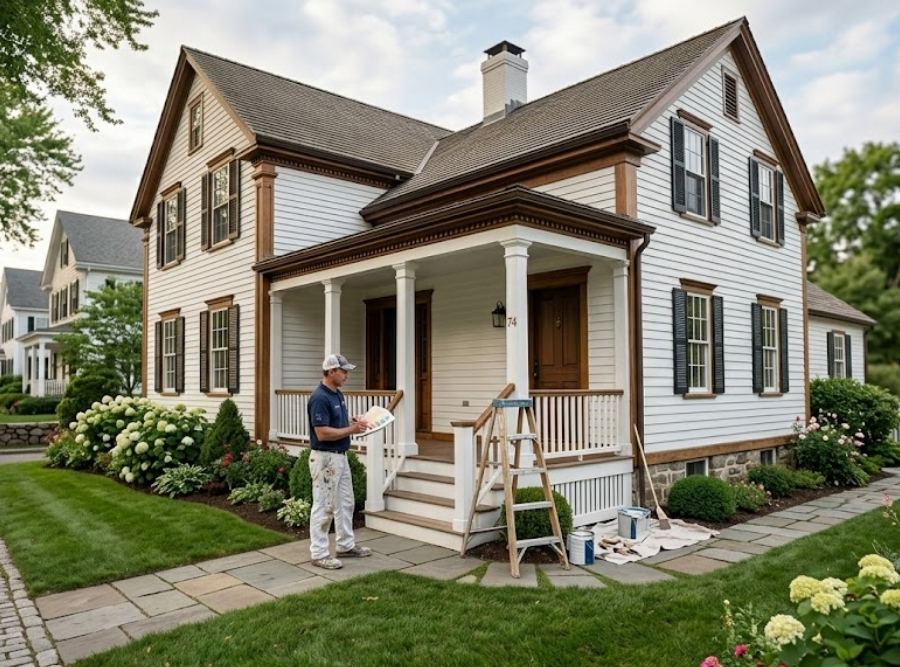
Do You Need Historic Commission Approval to Repaint a House in New London?
Whether you need Historic Commission approval to repaint in New London depends on where your property is located and exactly what work is planned. Routine repainting is often treated differently from exterior alterations, but if a home sits within one of New London’s local historic districts including the Downtown/Waterfront Historic District along Bank Street and Whale Oil Row, or the Williams Street corridor, it’s worth confirming current requirements before purchasing paint or scheduling work. Getting that answer early prevents delays and helps homeowners plan the project with confidence.
Is Every Old House in New London Subject to Historic Commission Review?
No, this is one of the most common misconceptions homeowners have. New London has many historic homes from the Colonial, Federal, Victorian, and early twentieth-century periods, but not every historic-looking property sits within a locally designated historic district. Homes in neighborhoods like Jefferson Avenue, Crystal Avenue, or Ocean Beach may be just as old without falling under the same review process as properties inside a designated district like the Downtown/Waterfront area around Bank Street or the Whale Oil Row Greek Revival houses on Huntington Street.
The first question isn’t whether repainting requires approval, it’s whether the property is actually located within a district where Historic Commission review applies. Confirming that status before scheduling painters or ordering materials removes most of the uncertainty around the project.
Is Repainting Treated the Same as Other Exterior Changes?
Not necessarily. A straightforward repaint using existing materials is different from replacing clapboards, rebuilding porch railings, installing new trim profiles, changing architectural details, or replacing historic windows, those larger changes may involve additional review, while routine maintenance is often approached differently.
This distinction matters because exterior painting projects commonly include minor repairs done as part of prep — scraping loose paint, replacing deteriorated caulk, and repairing small areas of damaged wood. These maintenance activities help preserve the home rather than change its appearance. Projects that substantially alter the building’s appearance or historic features are the ones more likely to need review. Since every property and project differs, it’s better to confirm which category a specific repaint falls into before assuming either way.
Should Homeowners Delay Repainting Over Approval Questions?
No, waiting is usually the wrong move. A more common problem than violating historic requirements is homeowners postponing needed maintenance out of uncertainty, while paint keeps fading, cracking, and peeling in the meantime. Along New London’s shoreline, moisture doesn’t pause for that hesitation: salt air, humidity, wind-driven rain, and freeze-thaw cycles keep affecting exposed wood every season. Once paint starts failing, moisture reaches the siding and trim more easily, and what could have stayed a straightforward repaint can grow into a project involving wood repair, trim restoration, or replacement of original historic material.
Historic homes have lasted for generations largely because they were maintained consistently — regular painting protects original clapboards, decorative trim, fascia, soffits, and porch details from unnecessary deterioration, and it’s typically far less costly than restoring weather-damaged wood after years of deferred maintenance.
Does Historic Home Color Choice Still Matter Even for Routine Maintenance?
Yes. Even when a repaint qualifies as routine maintenance, color choice still shapes how well the home reads within its architecture and neighborhood. A home built more than a century ago was designed with proportions, trim details, and decorative features that generally look best with colors that complement its period rather than compete with it.
In New London’s historic neighborhoods, well-maintained homes tend to favor balanced, timeless color combinations over bold, highly saturated modern palettes. Colonial homes often use restrained body colors with subtle trim contrast, while the Greek Revival houses of Whale Oil Row and similar Victorian-era properties may use several coordinated colors to highlight decorative woodwork without overwhelming it. This doesn’t mean every home should look identical, it does mean thoughtful color selection is part of what keeps a historic streetscape cohesive. Choosing colors suited to the home’s architecture, rather than a current trend, tends to hold up better over the long run.
Why Does Surface Preparation Matter So Much on a Historic Home?
Because many of New London’s older properties still have original clapboards, custom trim, and decorative woodwork that have survived for generations, and protecting that material starts before the first coat of paint goes on. Loose or failing paint needs to be removed carefully without unnecessarily damaging the wood beneath it, deteriorated caulk should be replaced, minor wood repairs completed, and bare surfaces properly primed before finish coats are applied. Skipping steps here tends to show up later as premature peeling, bubbling, or moisture damage that shortens the life of the new paint job.
Older homes also deserve extra attention because earlier paint layers may contain lead-based coatings, which changes how preparation should be approached. The goal isn’t to strip away the home’s history — it’s to stabilize and protect the original woodwork that gives the property its character.
If you’re planning to repaint a historic home in New London and aren’t sure whether your project needs additional review, the Simons Painting & Drywall team can help you confirm requirements and prepare the surface properly before work begins.
Learn more on our Exterior Painting page. Also serving Stonington Borough homeowners, see our Stonington Historic District guide for that district’s requirements.
Frequently Asked Questions About Repainting Historic Homes in New London
Do I need Historic Commission approval to repaint my house in New London?
It depends on whether the property is located within one of New London’s designated local historic districts and what the project involves — routine repainting is often treated differently from projects that change the home’s exterior appearance or architectural features. Homeowners should confirm their property’s status and the current requirements with the appropriate city office before starting work.
Is every old house in New London part of a historic district?
No. New London has many historic-looking homes throughout the city, but only properties within a locally designated historic district such as the Downtown/Waterfront district along Bank Street or the Whale Oil Row Historic District on Huntington Street are subject to that review process.
Does repairing wood or replacing caulk during a repaint count as a bigger alteration requiring review?
Typically not, minor repairs like scraping loose paint, replacing deteriorated caulk, and fixing small areas of damaged wood are usually considered part of routine maintenance rather than an exterior alteration. Larger changes, like replacing clapboards or historic windows, are more likely to involve additional review.
Should I wait to repaint my historic home until I confirm approval requirements?
No, delaying maintenance while paint continues failing typically makes the problem worse, since moisture reaching exposed wood can turn a straightforward repaint into a larger repair project. It’s better to confirm requirements promptly and move forward with maintenance before deterioration spreads.

Shea Simons is the owner of Simons Painting & Drywall, a family-owned painting and refinishing company serving Connecticut Shoreline communities from East Lyme and Niantic to Old Saybrook, Madison, and Mystic. Shea and his team specialize in interior and exterior painting, drywall repair and installation, and fine refinishing work for cabinets, furniture, and custom walls. Homeowners along the shoreline know Shea’s crew for meticulous prep work and a finish built to hold up against coastal salt air and humidity.