Best Exterior Paint for Salt Air on the CT Shoreline
For most Connecticut shoreline homes, the best-performing exterior coating system combines a premium 100% acrylic exterior paint with a penetrating primer on bare or repaired wood — elastomeric coatings are worth considering only on masonry or severely weathered substrates where flexibility and crack-bridging matter more than standard adhesion. No single product is “saltproof,” but 100% acrylic coatings outperform oil-based and lower-grade contractor paints because they stay flexible enough to move with wood siding through Connecticut’s humidity swings and freeze-thaw cycles. Preparation, not the product label is usually what determines whether that system lasts three years or fifteen.
Why Does Standard Exterior Paint Fail Near the CT Shoreline?
Salt doesn’t dissolve a properly applied coating, microscopic salt deposits settle on siding and trim and attract moisture, keeping surfaces damp longer than in a drier climate. At the same time, UV rays gradually weaken the paint film’s flexibility, so it can’t expand and contract with temperature swings as well as it once could. That repeated cycle of moisture, drying, and UV exposure wears down a standard finish faster than most homeowners expect. South-facing walls tend to fade fastest from sun exposure, while shaded walls stay damp longer and are more prone to mildew.
Left unaddressed, exterior paint typically fails in a predictable sequence:
- Color begins to fade.
- The finish develops a chalky or powdery texture.
- Hairline cracks appear.
- Moisture works beneath weakened areas.
- Blistering or peeling develops.
- Bare wood becomes exposed.
- Wood deterioration risk increases.
What Should You Look for in a Coastal-Grade Exterior Paint?
Premium 100% acrylic exterior coatings are the standard recommendation for most Connecticut shoreline homes because they offer better adhesion, flexibility, and color retention than older oil-based or lower-grade contractor paints. On masonry, stucco, or surfaces with existing hairline cracking, an elastomeric coating can be worth considering for its thicker film and crack-bridging properties though it’s a specialty option rather than a default choice for standard wood siding. Penetrating primers matter most on bare or repaired wood, since they seal porous surfaces before the finish coat goes on rather than sitting on top of them like a standard primer.
Product selection still depends on the specific home:
- Siding and trim material
- Condition of the existing paint
- Previous coating systems
- Direct shoreline exposure
- Moisture history
- Maintenance record
A historic clapboard home and a newer fiber cement home require different prep and sometimes different primers, even if painted the same color.
Why Does Application Matter as Much as Product Selection?
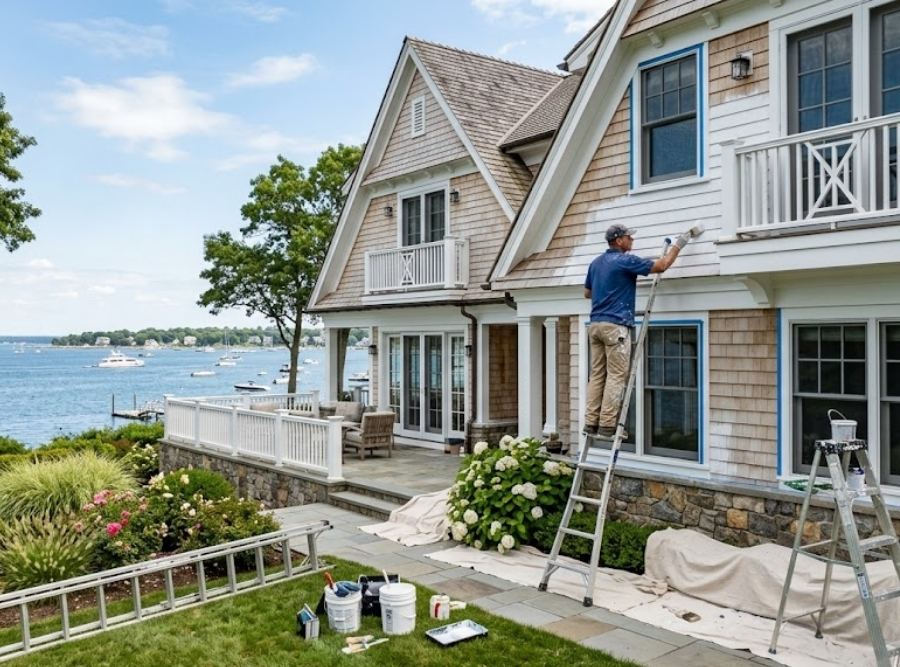
Premium paint applied over a poorly prepared surface will fail early regardless of price. Before any finish coat goes on, surfaces should be inspected for loose paint, weathered wood, deteriorated caulk, and moisture intrusion, with salt residue, mildew, and dirt removed first so they don’t interfere with adhesion. A full prep sequence typically includes:
- Washing to remove contaminants
- Scraping loose or failing paint
- Sanding rough transitions
- Repairing damaged wood
- Replacing failed caulk
- Priming bare wood and repaired areas with a penetrating primer where needed
- Selecting compatible coatings for the existing substrate
Homes that have been spot-painted repeatedly over the years are especially at risk — individual touch-ups age at different rates, and eventually multiple layers lose adhesion together, turning a routine maintenance job into a full repaint.
What Are the Early Warning Signs That Exterior Paint Is Failing?
Paint rarely fails all at once, most homes show warning signs long before large sections peel:
- Chalky white residue transfers to your hand after touching siding
- Faded or uneven color
- Small bubbles after humid weather
- Hairline cracking around trim
- Caulk pulling away from windows or doors
- Paint lifting at edges and corners
- Rust stains around exposed fasteners
- Bare wood visible in isolated spots
Once wood is exposed, repeated wet-dry cycles can cause swelling, checking, and eventually decay if maintenance is postponed.
Do All Shoreline Homes Need the Same Coating System?
No. Exposure varies significantly even within the same town. A home shielded by mature trees inland in Flanders weathers more slowly than a home directly overlooking Niantic Bay or in an exposed neighborhood like Giants Neck, Black Point, or Crescent Beach, where salt-laden air and wind are constant. Historic homes need extra consideration too, since older wood siding and trim often call for breathable coating systems rather than another heavy coat over existing layers — a case where a standard acrylic system, applied correctly, often outperforms a heavier elastomeric product that can trap moisture in older wood.
One common misconception: “marine paint” isn’t the answer. Marine coatings are engineered for boats under different conditions than residential siding, a properly selected exterior house paint system for clapboards, cedar shingles, or fiber cement is built to resist moisture, sun, and weathering on a home, not to be waterproof like a hull.
If your home is showing chalking, fading, peeling, or exposed wood, it’s worth having the full coating system evaluated rather than just buying another can of paint. The Simons Painting & Drywall team serves homeowners throughout the Connecticut shoreline, including Niantic and East Lyme, and can recommend the right acrylic, elastomeric, or primer system for your home’s specific exposure.
Learn more on our Exterior Painting page, or see our East Lyme and Niantic location pages.
Frequently Asked Questions About Exterior Paint and Salt Air
What’s the best type of exterior paint for a house near the CT shoreline?
Premium 100% acrylic exterior paint is the standard recommendation for most shoreline homes, since it stays flexible enough to handle humidity swings and temperature changes better than oil-based or lower-grade paints. Elastomeric coatings are a specialty option worth considering mainly for masonry or already-cracked surfaces, not a default replacement for acrylic on wood siding.
Does salt air actually damage exterior paint, or is that a myth?
Salt air doesn’t dissolve paint directly, but salt deposits on siding attract and hold moisture, which combined with UV exposure weakens the paint film over time. This accelerated moisture-UV cycle is why homes on the Connecticut shoreline typically need repainting sooner than homes farther inland.
Is marine paint better for homes near the water?
No. Marine paint is formulated for boat hulls under constant water submersion, not for wood or fiber cement siding exposed to air, sun, and occasional moisture. A properly selected exterior house paint system is built specifically for residential building materials.
Can premium paint make up for skipping surface preparation?
No. Even the highest-quality paint will fail early over loose paint, damp wood, or deteriorated caulk. Preparation — washing, scraping, repairing, and priming with the right primer for the substrate is what allows any paint, premium or standard, to reach its expected lifespan.
Shea Simons is the owner of Simons Painting & Drywall, a family-owned painting and refinishing company serving Connecticut Shoreline communities from East Lyme and Niantic to Old Saybrook, Madison, and Mystic. Shea and his team specialize in interior and exterior painting, drywall repair and installation, and fine refinishing work for cabinets, furniture, and custom walls. Homeowners along the shoreline know Shea’s crew for meticulous prep work and a finish built to hold up against coastal salt air and humidity.