How Long Does Drywall Take to Dry Before Painting?
Joint compound on drywall typically needs 24 to 48 hours to fully dry between coats under normal conditions, and a full drywall repair or installation usually needs at least 24 hours after the final coat before priming and painting. Along the Connecticut shoreline, coastal humidity can extend that timeline significantly in Stonington and similar areas, drying times of 48 to 72 hours aren’t unusual during humid stretches. Painting over drywall or joint compound that hasn’t fully dried is one of the most common causes of early paint failure, so it’s worth confirming dryness rather than working off a fixed calendar estimate.
How Long Does Joint Compound Need to Dry Between Coats?
Under normal indoor conditions — moderate humidity, decent airflow, room temperature — a coat of joint compound typically dries in 24 hours before the next coat can be applied. Thicker applications, such as those used for bigger patches or seams, may need closer to 48 hours. This drying time isn’t just a guideline for convenience applying a second coat over compound that’s still damp underneath can trap moisture, leading to cracking or bubbling once paint is applied over it later.
Why Does Coastal Humidity in Stonington Extend Drying Time?
Joint compound dries primarily through evaporation, and evaporation slows down as ambient humidity rises. Stonington’s coastal location means the air frequently carries more moisture than inland Connecticut towns, especially during summer months or extended damp stretches. This can push standard 24-hour drying estimates out to 48 or even 72 hours, particularly for thicker applications or rooms with limited ventilation. Homes with older construction and less consistent airflow common in some of Stonington’s historic properties can see this effect even more pronounced.
How Can You Tell If Drywall or Joint Compound Is Actually Dry?
Relying only on a calendar estimate can be misleading given how much humidity affects the timeline. More reliable indicators include:
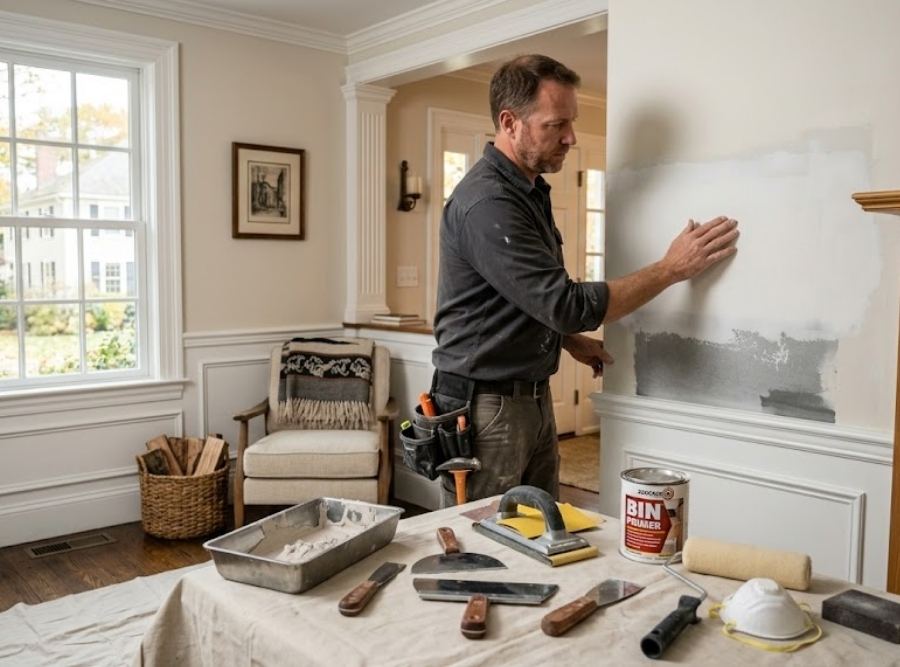
- Color change: most joint compounds dry to a uniform white or off-white from a darker, wet-looking gray — if any darker patches remain, it’s likely still damp underneath.
- Touch test: dry compound feels hard and cool to the touch, not soft, tacky, or cold.
- No visible sheen: wet compound often has a slightly glossy or damp-looking surface; dry compound looks matte and consistent.
- Sanding test: dry compound sands into fine powder; wet compound tends to clump or gum up sandpaper.
If any of these checks suggest lingering moisture, it’s worth waiting longer rather than proceeding to primer and paint.
What Happens If You Paint Over Drywall or Compound Too Soon?
Painting over compound or drywall that hasn’t fully dried is one of the more common causes of early paint failure, and the problems it creates typically include:
- Cracking or crazing in the paint film as trapped moisture escapes
- Bubbling or blistering, since the paint traps moisture rather than letting it evaporate normally
- Poor adhesion, causing the paint to peel prematurely
- Visible texture or sheen differences where the compound didn’t fully cure before priming
These issues usually don’t show up immediately, they tend to appear weeks or months later as the trapped moisture finally works its way out, which is part of why rushing this step is a common regret.
Does Priming Help Speed Up the Process, or Should You Wait Longer?
Priming isn’t a substitute for adequate drying time, it should be applied after the compound is confirmed dry, not as a way to seal in remaining moisture faster. A quality primer designed for drywall does help equalize porosity between the compound and surrounding drywall (which also reduces flashing issues), but it performs best over a surface that’s already fully cured rather than one that’s still drying underneath.
If you’re planning a drywall repair or installation project in Stonington or another shoreline community and want to make sure the timeline accounts for local humidity, the Simons Painting & Drywall team can help plan proper drying time into the schedule.
Learn more on our Drywall Repair & Installation page.
Frequently Asked Questions About Drywall Drying Time
How long should I wait to paint after a drywall repair?
Under normal conditions, wait at least 24 hours after the final coat of joint compound before priming and painting, though this can extend to 48–72 hours in humid coastal areas like Stonington. Checking for a uniform dry color and firm, cool touch is more reliable than relying on a fixed number of hours alone.
Does humidity really make that much difference in drywall drying time?
Yes, joint compound dries through evaporation, which slows considerably as humidity rises, so a coastal town like Stonington can see drying times nearly double compared to a drier inland location. This is especially true during summer months or extended damp weather.
What happens if I paint over drywall compound too early?
Painting over compound that hasn’t fully dried commonly leads to cracking, bubbling, or poor paint adhesion as trapped moisture tries to escape after the fact. These problems often don’t appear right away — they can show up weeks or months later once the moisture finally works its way out.
How can I tell if joint compound is dry without waiting a set number of days?
Check for a uniform white or off-white color (wet compound looks darker and slightly glossy), and test that it feels hard and cool rather than soft or tacky. If it sands into a fine powder rather than clumping, that’s another reliable sign it’s fully cured.
Shea Simons is the owner of Simons Painting & Drywall, a family-owned painting and refinishing company serving Connecticut Shoreline communities from East Lyme and Niantic to Old Saybrook, Madison, and Mystic. Shea and his team specialize in interior and exterior painting, drywall repair and installation, and fine refinishing work for cabinets, furniture, and custom walls. Homeowners along the shoreline know Shea’s crew for meticulous prep work and a finish built to hold up against coastal salt air and humidity.