
What Causes Mildew on Interior Walls — and How to Paint Over It Correctly
Mildew on interior walls is caused by excess moisture combined with poor ventilation, most often in bathrooms, basements, or rooms with limited airflow and it needs to be properly cleaned and the moisture source addressed before painting, not just painted over. Painting directly over mildew without removing it and correcting the underlying moisture problem almost always results in the mildew reappearing through the new paint within months. Waterford’s coastal humidity makes certain rooms more prone to this than a drier inland location, which makes proper ventilation and moisture control especially relevant here.
What Actually Causes Mildew to Grow on Interior Walls?
Mildew is a type of surface mold that grows wherever moisture, organic material (like dust, drywall paper, or paint), and limited airflow combine. The most common contributing conditions include:
- High humidity: rooms that regularly sit above roughly 60% relative humidity provide the moisture mildew needs to establish and spread.
- Poor ventilation: bathrooms without a working exhaust fan, basements with limited airflow, and rooms with few operable windows trap moisture rather than letting it dissipate.
- Condensation: cold surfaces meeting warm, humid air — common on exterior walls in winter or around poorly insulated areas creates the moisture mildew thrives on.
- Water intrusion: leaks from plumbing, roofing, or window flashing introduce ongoing moisture that mildew will keep returning to as long as the source is unaddressed.
- Limited sunlight: north-facing rooms or spaces that rarely see direct light tend to stay damper longer than sun-exposed rooms.
Why Is Waterford’s Coastal Location a Factor Here?
Coastal humidity means the ambient moisture level indoors tends to run higher than in a drier inland town, which puts more baseline pressure on rooms that are already prone to poor airflow — bathrooms, basements, and interior rooms with limited natural ventilation. This doesn’t mean every room in a Waterford home is at elevated risk, but it does mean that rooms without adequate exhaust fans or dehumidification may see mildew develop faster or more persistently than the same room would in a drier climate.
How Can You Tell Mildew Apart From Ordinary Dirt or Dust?
A few checks help distinguish mildew from a simple dirt stain:
- Color and pattern: mildew often appears as black, gray, or greenish speckled spots, frequently clustered in corners, along baseboards, or around window and door frames.
- The bleach test: dabbing a small, inconspicuous spot with diluted household bleach — if the spot lightens significantly within a couple of minutes, it’s likely mildew; ordinary dirt generally won’t respond the same way.
- Musty odor: a persistent musty smell in the room, even after cleaning, often indicates mildew growth somewhere nearby, sometimes behind the wall surface itself.
- Recurrence after cleaning: dirt generally stays gone once wiped away; mildew tends to reappear in the same spot within weeks if the underlying moisture issue isn’t resolved.
Why Doesn’t Simply Painting Over Mildew Work?
Painting directly over mildew traps the existing growth beneath the new coat rather than removing it, and since the paint doesn’t address the moisture feeding it, mildew commonly grows back through the new paint layer within a matter of months. Standard interior paint also isn’t formulated to kill existing mildew spores, at best it temporarily hides the visible staining while the underlying growth continues underneath, which often shows up as discoloration bleeding through the fresh coat or a returning musty smell.
How Do You Properly Remove Mildew Before Painting?
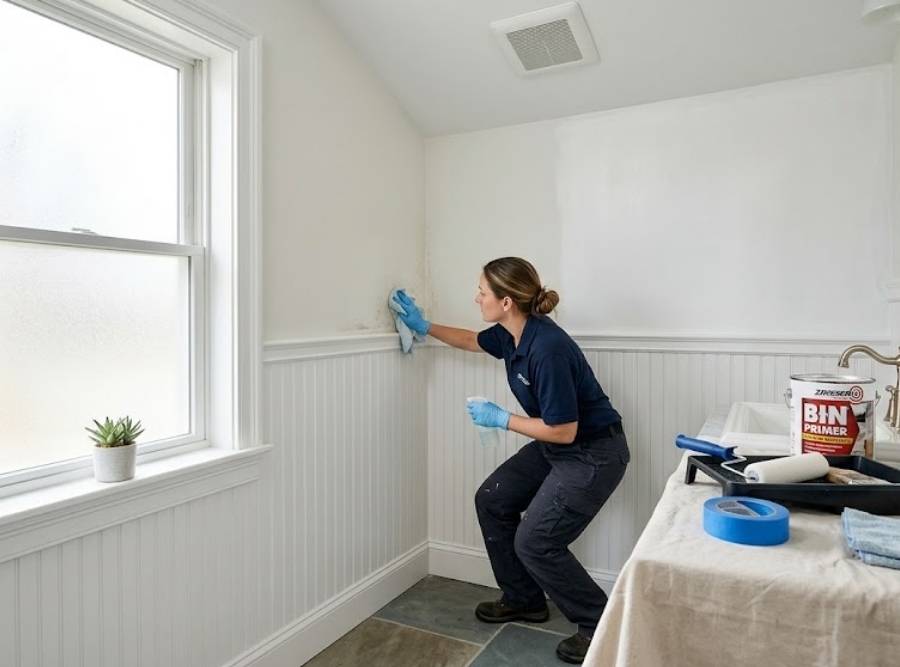
A proper mildew remediation and paint prep process typically includes:
- Identifying and correcting the moisture source — repairing a leak, adding ventilation, or addressing condensation before any surface treatment, since cleaning without fixing the cause is a temporary measure at best.
- Cleaning the affected area with a mildew-specific cleaner or a diluted bleach solution, following proper ventilation and safety precautions.
- Allowing the surface to fully dry, which can take longer than expected in a humid room.
- Sanding lightly if the mildew has affected the texture of drywall or existing paint.
- Applying a mildew-resistant, stain-blocking primer specifically formulated to seal the area and inhibit future growth.
- Finishing with a paint formulated for high-moisture areas, particularly in bathrooms or other rooms prone to humidity.
Skipping the moisture correction step and going straight to cleaning and repainting is the most common reason mildew returns even after what looked like a thorough cleaning.
What Rooms in a Waterford Home Are Most Prone to Mildew?
Bathrooms without adequate exhaust ventilation, basements with limited airflow and higher ambient humidity, and rooms with exterior walls that see condensation in colder months are the most common trouble spots. Rooms near frequently opened windows or exterior doors can also see more humidity exposure than interior rooms with more controlled conditions. If mildew keeps appearing in the same room despite cleaning, it’s worth having the ventilation and any potential moisture sources evaluated rather than continuing to treat it as a recurring cosmetic issue.
When Should You Call a Professional Instead of Handling It Yourself?
A small, isolated mildew spot with an obvious, fixable cause like a bathroom without an exhaust fan is often manageable as a DIY cleaning and repaint project. Widespread mildew, mildew that keeps returning despite proper cleaning, or mildew connected to a suspected leak or larger moisture problem is worth having professionally assessed, since the visible mold on the surface may only reflect part of a larger moisture issue behind the wall.
If mildew keeps showing up on your interior walls in Waterford and you’re not sure whether it’s a ventilation issue or something more, the Simons Painting & Drywall team can assess the affected area and recommend the right prep and paint approach.
Learn more on our Interior Painting page, or see our Waterford location page.
Frequently Asked Questions About Mildew on Interior Walls
Can I just paint over mildew on my walls instead of removing it first?
No, painting directly over mildew traps the existing growth under the new coat rather than removing it, and since the paint doesn’t address the moisture feeding it, mildew commonly reappears through the fresh paint within a few months. The mildew needs to be properly cleaned and the moisture source corrected before painting.
How do I know if a stain on my wall is mildew or just dirt?
Mildew often shows up as black, gray, or greenish speckled spots, sometimes with a musty smell, and testing a small spot with diluted bleach will typically lighten it noticeably if it’s mildew — ordinary dirt won’t respond the same way. Recurrence after cleaning is another strong indicator, since dirt generally stays gone once wiped away while mildew tends to return if the moisture issue isn’t fixed.
Why does mildew keep coming back in my bathroom even after I clean it?
If the room lacks adequate ventilation — no working exhaust fan, or a fan that’s rarely used during and after showers — the underlying moisture that feeds mildew growth never actually gets addressed, so cleaning alone only provides a temporary fix. Adding or using proper ventilation is usually necessary alongside cleaning to stop mildew from returning.
Does Waterford’s coastal humidity make mildew more likely on interior walls?
It can, particularly in rooms with limited ventilation, since coastal humidity raises the baseline moisture level indoors compared to a drier inland location. Rooms like bathrooms and basements without adequate airflow are especially prone to this effect.

Shea Simons is the owner of Simons Painting & Drywall, a family-owned painting and refinishing company serving Connecticut Shoreline communities from East Lyme and Niantic to Old Saybrook, Madison, and Mystic. Shea and his team specialize in interior and exterior painting, drywall repair and installation, and fine refinishing work for cabinets, furniture, and custom walls. Homeowners along the shoreline know Shea’s crew for meticulous prep work and a finish built to hold up against coastal salt air and humidity.