
How to Match Paint Colors in an Older Home With Multiple Previous Paint Jobs
Matching paint color in an older home with layers of previous paint jobs starts with professional color matching from a physical sample — not guessing based on the name or code of an old paint can, which may no longer be accurate after years of fading, discontinued formulations, or a can that was never the exact color to begin with. A paint store can scan a small removed sample or a hidden painted area to generate a close match, but getting a truly seamless result in an older New London home often depends as much on surface prep and application as it does on the color itself.
Why Is Matching Paint in an Older Home Harder Than It Sounds?
A few factors specific to older homes make this more complicated than simply reordering “the same color”:
- Paint fades and shifts over time: UV exposure, cleaning products, and simple aging can shift a color’s actual appearance well away from how it looked when first applied, even if you have the original can or code.
- Discontinued colors and formulations: paint manufacturers regularly update or discontinue specific colors and mixing formulas, so an old paint code may no longer correspond to an available product, or the same code may now mix slightly differently.
- Multiple layers with different original colors: many older homes have been painted several times over the decades, sometimes with different colors beneath the current one, which affects how new paint reads if any of those old layers show through worn or thin spots.
- Old cans aren’t reliable references: paint separates, changes color slightly in the can over time, and may not accurately represent the color as it currently appears on the wall.
How Does Professional Color Matching Actually Work?
The most reliable approach is matching from the wall itself, not from an old can or a written-down code:
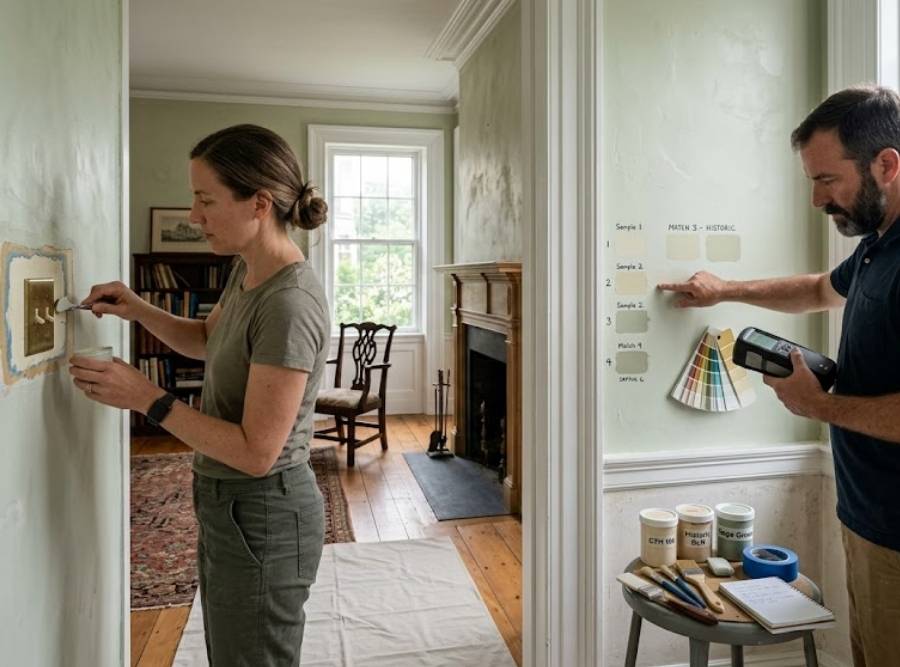
- A small sample is taken from a section of the existing painted surface — often from a spot that will be covered anyway, like behind a switch plate or in a closet.
- That sample is scanned using a spectrophotometer at a paint store, which reads the actual current color rather than relying on a label or code.
- The store’s software calculates a matching formula based on that reading, adjusting for the specific paint line and finish being used.
- A test sample is mixed and applied to a small, inconspicuous area to confirm the match before committing to a full room.
This process accounts for how the color has actually aged and faded on the wall, rather than assuming an old can or code still represents today’s reality.
What If You Don’t Have Access to a Hidden, Unfaded Sample?
If every visible surface has faded or aged similarly, and there’s no untouched area to sample from, a professional can still get a close match by:
- Sampling from the least-exposed area available, even if it’s shown some fading, and adjusting from there
- Using the paint store’s color-matching software alongside a physical comparison against paint chips in similar tones
- Testing a mixed sample against the existing wall in different lighting conditions — natural daylight, evening light, and artificial light all reveal different things about how close a match actually is
A close match achieved this way may not be pixel-perfect, but it’s typically close enough that the difference isn’t noticeable once applied, especially compared to guessing from an old paint code.
Why Does This Matter More for a Touch-Up Than a Full Repaint?
If you’re repainting an entire room, an imperfect color match matters far less, since the whole surface gets the same new color regardless of what was there before. Color matching becomes critical specifically for touch-ups and partial repairs — patching a section of wall, repainting trim in one room to match adjoining rooms, or blending a repair into an otherwise untouched wall. In these situations, even a slightly off match will be visible, sometimes more so under certain lighting, which is why getting the match right before starting matters more than it would for a full room repaint.
Does the Original Paint’s Sheen Affect the Match, Not Just the Color?
Yes. Sheen affects how light reflects off a surface, which changes how a color appears even when the underlying pigment is identical. A perfectly color-matched paint in the wrong sheen — satin instead of the original eggshell, for example can still look mismatched once applied, since the two surfaces will reflect light differently. Confirming both the color and the sheen of the existing paint is necessary for a truly seamless match, not just the color alone.
How Does This Play Out Specifically in Older New London Homes?
Many older homes throughout New London have gone through multiple paint jobs over decades, sometimes by different owners with different color choices, and original plaster walls that absorb and age paint somewhat differently than modern drywall. This makes a physical sample and professional matching process particularly valuable here, since assuming a color based on an old paint can or a memory of “what it used to look like” is less reliable in a home with this kind of layered painting history.
If you’re trying to match paint for a touch-up or partial repaint in your New London home, the Simons Painting & Drywall team can take a proper sample and get an accurate match before starting work.
Learn more on our Interior Painting page, or see our New London location page.
Frequently Asked Questions About Matching Paint Colors
Can I just use the paint code from an old can to match my wall color?
Not reliably, paint fades and shifts over time due to UV exposure and age, so an old code or can may no longer represent how the color actually looks on your wall today. A physical sample taken from the current wall and professionally scanned is a more accurate way to get a true match.
What if I don’t have any leftover paint or the color code from my walls?
A paint store can take a small sample directly from an inconspicuous area of the existing wall behind a switch plate or inside a closet and scan it to generate a matching formula. This is generally more accurate than trying to match based on memory or a general color description.
Why does my touch-up paint look different from the surrounding wall even though it’s supposedly the same color?
This is often due to a sheen mismatch rather than a color mismatch, the same color in a different sheen reflects light differently and can look noticeably off even when the pigment is correct. It can also happen if the surrounding paint has faded or aged since it was applied, making even a perfectly matched fresh color look slightly different by comparison.
Does it matter if my home has been painted multiple times over the years with different colors?
It can, particularly for repairs or touch-ups where worn or thin spots might let an older layer show through slightly. For a full room repaint this isn’t usually a concern, since the entire surface receives uniform new coverage regardless of what’s underneath.

Shea Simons is the owner of Simons Painting & Drywall, a family-owned painting and refinishing company serving Connecticut Shoreline communities from East Lyme and Niantic to Old Saybrook, Madison, and Mystic. Shea and his team specialize in interior and exterior painting, drywall repair and installation, and fine refinishing work for cabinets, furniture, and custom walls. Homeowners along the shoreline know Shea’s crew for meticulous prep work and a finish built to hold up against coastal salt air and humidity.