
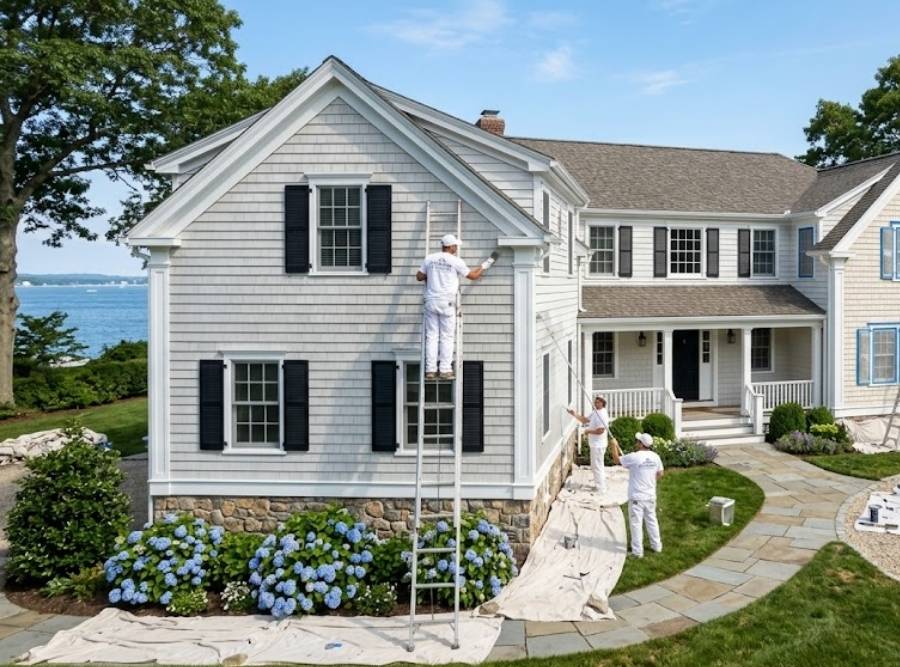
How Much Does It Cost to Paint the Exterior of a House in Connecticut?
Exterior house painting in Connecticut typically costs between $1.50 and $4.50 per square foot of paintable surface, which translates to roughly $2,000 to $10,000 for a full exterior repaint on a typical single-family home, depending on size, siding type, and how much prep work is needed. Coastal Connecticut homes tend to land toward the higher end of that range more often than inland properties, largely because salt air and humidity exposure typically mean more prep work is needed before paint goes on. These are general industry ranges, not a quote, an in-home assessment is the only way to get an accurate number for a specific property.
What Determines Where a Project Falls Within That Price Range?
A few factors consistently move the number up or down:
- Home size: More square footage means more paint, more labor hours, and more prep — larger homes cost more in total, though the per-square-foot rate can actually decrease slightly on bigger jobs due to efficiency.
- Number of stories and roofline complexity: Multi-story homes require additional scaffolding, ladder work, or lift equipment, which adds labor cost and safety considerations that a single-story ranch doesn’t need.
- Siding material: Wood clapboard, cedar shingle, vinyl, fiber cement, and stucco all require different prep methods and sometimes different primers, which affects both labor time and material cost.
- Condition of the existing paint: A home with failing paint, exposed bare wood, or multiple peeling layers needs significantly more prep than one simply due for a routine refresh — this is often the single biggest cost variable.
- Paint quality: Premium 100% acrylic exterior paints cost more per gallon than budget options, but they also tend to last longer, which affects the true cost per year of protection rather than just the upfront number.
Why Do Coastal Connecticut Homes Often Cost More to Paint Than Inland Homes?
Salt air, humidity, and stronger coastal UV exposure accelerate paint wear compared to inland Connecticut, which means coastal homes more frequently need the kind of prep work that raises overall project cost, scraping more extensively, replacing deteriorated caulk, repairing moisture-damaged trim, or priming more bare wood than an inland home of the same age and size might need. This isn’t a separate “coastal pricing tier” so much as a reflection of what condition assessment typically finds on a home that’s been exposed to salt air and wind-driven rain for years. A home in East Lyme or another shoreline town that’s been well-maintained with regular repainting can still come in at the lower end of the range — the condition of the existing coating matters more than the zip code itself.
What’s Typically Included in an Exterior Painting Quote?
A complete exterior painting estimate should account for more than just paint and labor to apply it. Line items to expect or ask about include:
- Washing the exterior to remove dirt, mildew, and salt residue
- Scraping and sanding loose or failing paint
- Repairing damaged wood or siding where needed
- Replacing deteriorated caulk around windows, doors, and trim
- Priming bare or repaired areas
- Two coats of finish paint on siding and trim
- Cleanup and disposal of scraped material and debris
If a quote seems significantly lower than others you’ve received, it’s worth asking specifically what prep work is included, a lower number sometimes reflects less thorough preparation rather than a better deal, and that gap tends to show up as premature paint failure within a season or two.
Does a Historic Home or Historic District Add to the Cost?
It can, for a couple of reasons. Historic homes often have original wood siding, trim, and architectural details that require more careful, time-intensive prep than newer construction — aggressive methods that work fine on modern siding can damage material that’s difficult to replace. Additionally, if a property sits within a designated historic district, a required color review process can add time to the project timeline, though this is generally a scheduling factor rather than a significant direct cost addition. It’s worth building that review time into your planning if your home is in a historic district area.
How Can You Get an Accurate Estimate for Your Specific Home?
General cost ranges are useful for budgeting, but the only way to get a number that reflects your actual home is an in-person assessment of the siding condition, square footage, architectural details, and any repair needs. A thorough estimate should walk through what prep work the quote includes, not just a single lump-sum number.
If you’re planning an exterior painting project in East Lyme or elsewhere along the Connecticut shoreline, the Simons Painting & Drywall team can provide a detailed, in-home assessment and estimate based on your home’s specific condition and exposure.
Learn more on our Exterior Painting page, or see our East Lyme location page.
Frequently Asked Questions About Exterior Painting Costs in Connecticut
How much does it cost to paint the exterior of an average-sized house in Connecticut?
Most homeowners can expect somewhere between $2,000 and $10,000 for a full exterior repaint, depending on home size, siding condition, and how much prep work is needed. An in-home assessment is the most reliable way to get a number specific to your property.
Why do coastal Connecticut homes sometimes cost more to paint than inland homes?
Salt air, humidity, and stronger coastal UV exposure often mean more extensive prep work is needed — more scraping, caulk replacement, or wood repair which is usually the main driver of higher cost rather than a separate coastal pricing rate. A well-maintained coastal home can still fall on the lower end of typical ranges.
What’s usually the biggest factor in exterior painting cost?
The condition of the existing paint and siding typically has more impact on total cost than the size of the home alone, since a home needing extensive scraping, wood repair, and priming requires significantly more labor than one simply due for a routine refresh.
Does painting a historic home cost more than painting a newer home?
It can, mainly because original wood siding and trim on historic homes often need more careful, time-intensive prep than modern materials, and homes within a historic district may need a color review process that adds time to the schedule. The direct cost impact varies by property and district requirements.

Shea Simons is the owner of Simons Painting & Drywall, a family-owned painting and refinishing company serving Connecticut Shoreline communities from East Lyme and Niantic to Old Saybrook, Madison, and Mystic. Shea and his team specialize in interior and exterior painting, drywall repair and installation, and fine refinishing work for cabinets, furniture, and custom walls. Homeowners along the shoreline know Shea’s crew for meticulous prep work and a finish built to hold up against coastal salt air and humidity.